UNIDO Day 2026 High-Level Dialogue:
Global partnerships promote the development of the blue economy industry
12 June, 2026
The ocean serves as a blue lifeline connecting global trade, energy supply, environmental protection, and climate action. Its interconnected nature means that the development of the blue economy has never been the endeavor of a single country or enterprise alone. From transboundary marine pollution control and international shipping decarbonization to joint technological innovation and coordinated global value chains, every step toward a sustainable blue economy depends on strong international partnerships.
During the High-Level Dialogue session of UNIDO Day 2026, industry leaders and international experts from environmental technology, advanced manufacturing, climate action, water treatment, and marine engineering sectors came together to exchange insights on the theme “Connecting Global Partnership for a Shared Blue Economy,” The discussion was moderated by Nishtha MEHTA, International Senior Advisor of the UNIDO Center of Excellence on Artificial Intelligence and Digital Transformation.
Drawing on their practical experience and industry achievements, the speakers shared valuable perspectives on cross-border investment, international cooperation, and the development of global industrial ecosystems. Together, they explored both the opportunities and challenges facing the blue economy. Participants agreed that amid an increasingly complex and uncertain global landscape, no country, enterprise, or institution can thrive in isolation. Sustainable progress requires a systemic approach, deeper international cooperation, and a shared commitment to multilateral values. By fostering interconnected cross-border industrial ecosystems and strengthening global partnerships, stakeholders can navigate uncertainty, accelerate the green transition of the ocean economy, advance sustainable development, and jointly create a more resilient, inclusive, and mutually beneficial future for the blue economy.
Related Reading: https://mp.weixin.qq.com/s/xqtRM-iwV6a7Cm2vNvtEIQ
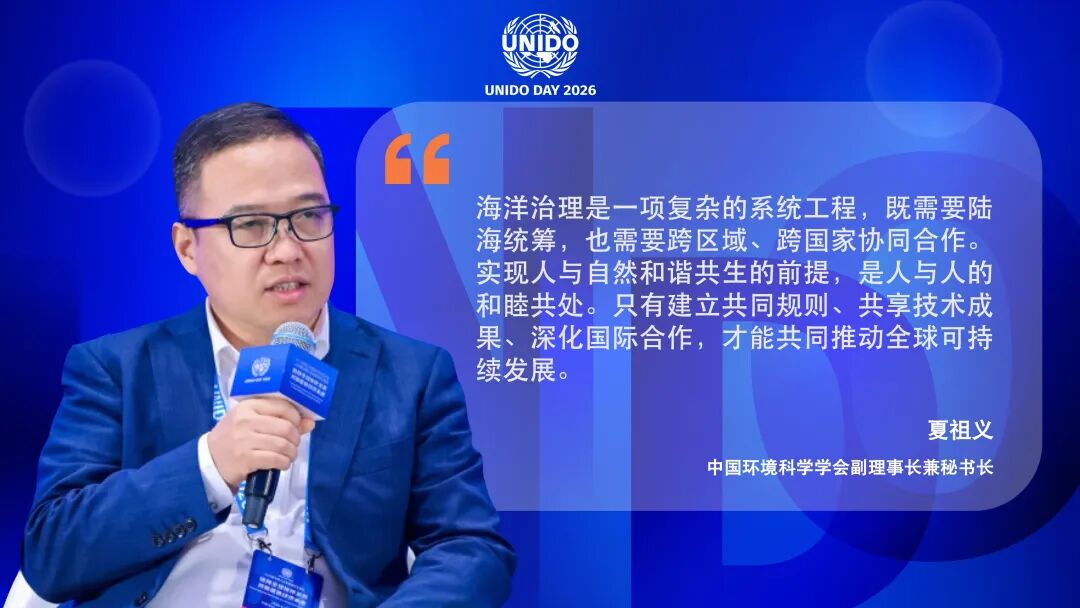
Mr. Xia Zuyi, Secretary-General of the Chinese Society for Environmental Sciences (CSES). He emphasized that ocean governance is a complex systematic project that requires both land-sea coordination and cross-regional and cross-national collaborative cooperation. The prerequisite for achieving harmonious coexistence between humans and nature is the harmonious coexistence among humans. Only by establishing shared rules, sharing technological achievements, and deepening international cooperation can we jointly promote global sustainable development.
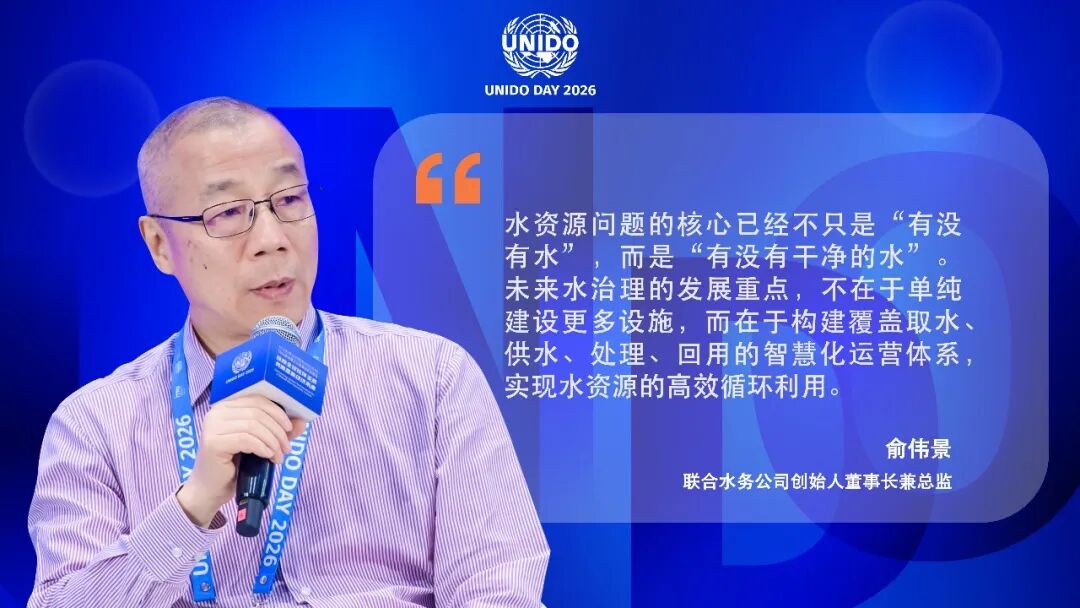
Mr. Yu Weijing, Founder and Chairman of United Water Corporation. He emphasized that the core of the water resource issue is no longer merely "whether there is water", but "whether there is clean water". The future development focus of water governance lies not in simply building more facilities, but in establishing a smart operation system covering water collection, supply, treatment, and reuse, to achieve efficient recycling and utilization of water resources.
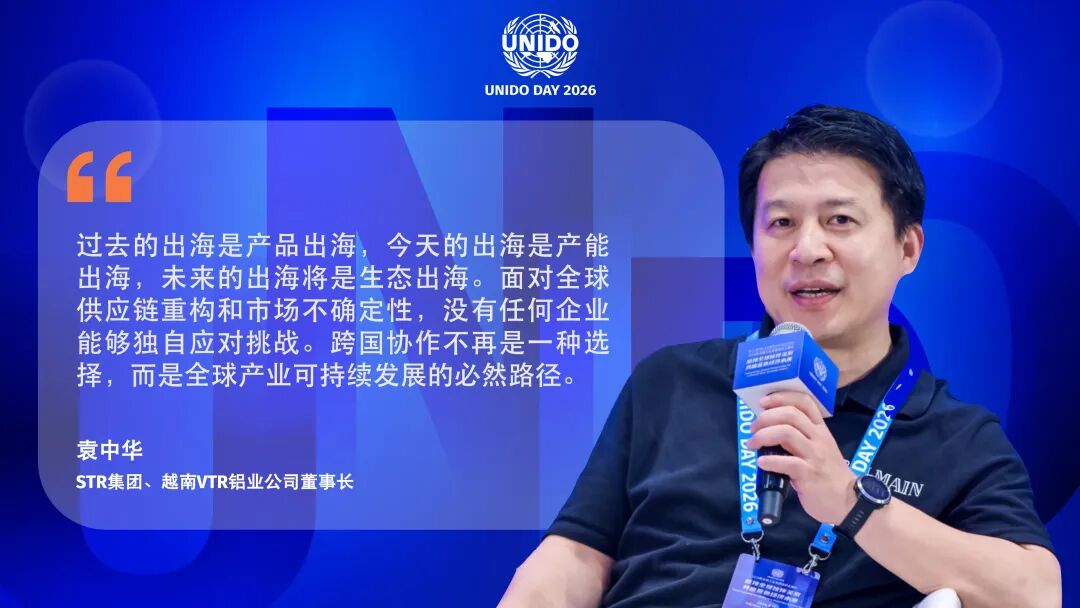
Mr. Yuan Zhonghua, Chairman of STR Group and VTR Aluminum Vietnam. He pointed out that in the past, the overseas expansion was about exporting products; today, it is about exporting production capacity; and in the future, it will be about exporting the ecosystem. Faced with the restructuring of global supply chains and market uncertainties, no enterprise can tackle these challenges alone. Transnational collaboration is no longer an option; rather, it is an inevitable path towards sustainable development of global industries.
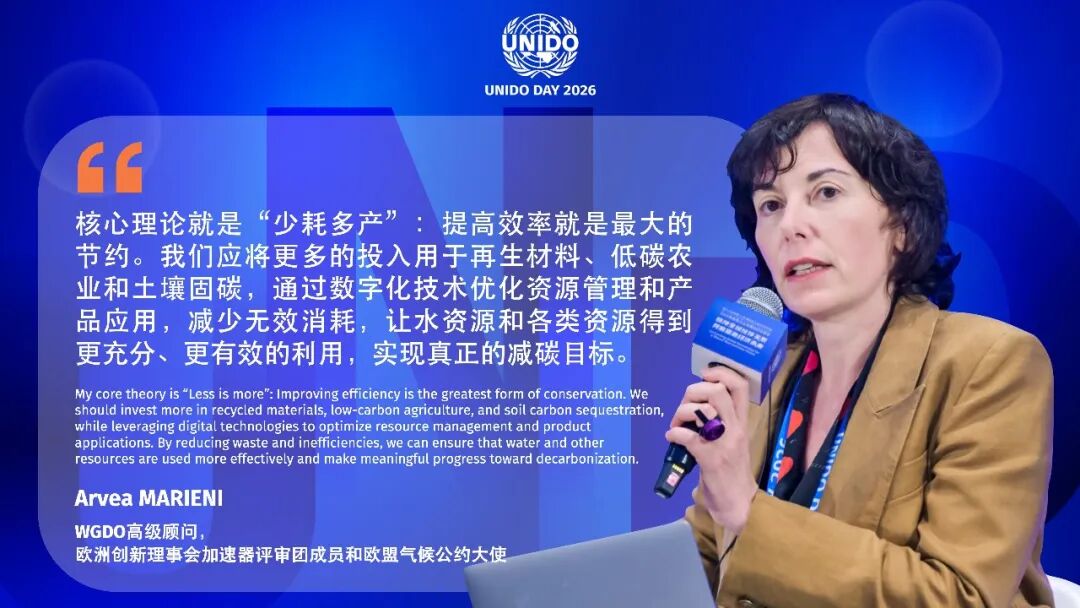
Ms. Arvea Marieni, Senior Advisor to WGDO and EU Climate Pact Ambassador. She argued that my core theory is "Less is more": important efficiency is the greatest form of conservation. We should invest more in recycled materials, low-carbon agriculture, ans soil carbon sequestration, while leveraging digital technologies to optimize resource management and product applications. By reducing waste and inefficiencies, we can ensure that water and other resources are used more efficiently and make meaningful progress toward decarbonization.
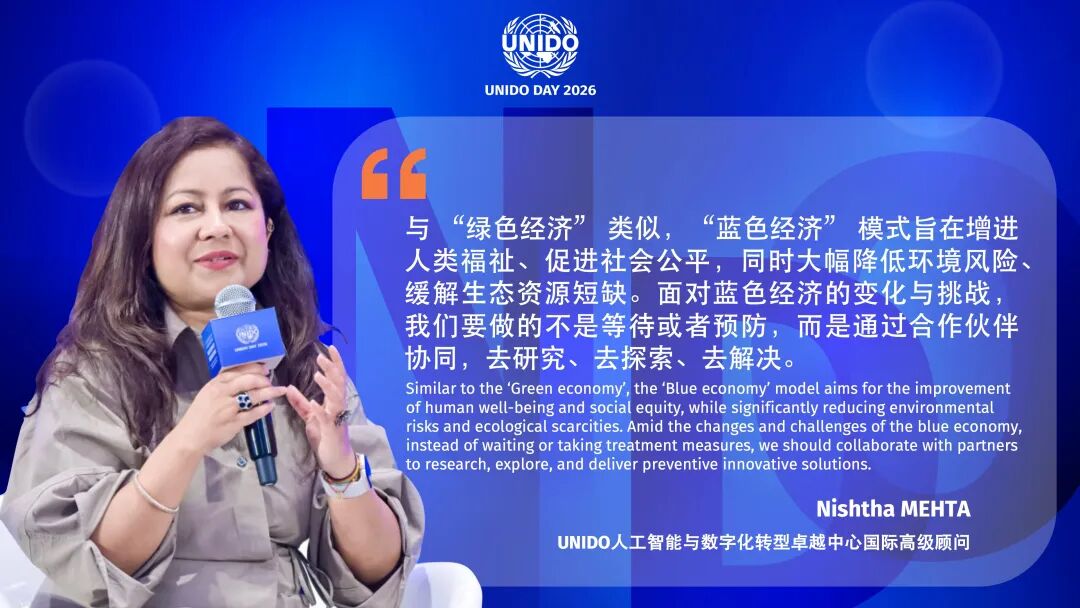
Ms. Nishtha MEHTA, Facilitator, Innovation Leadership Coash, PCC ICF, Senior Advisor, International Centers of Excellences for AI and Digital transformation, UNIDO. She pointed out that Similar to the 'Green economy', the 'Blue economy' model aims for the improvement of human well-being and social equality, while significantly reducing environmental rists and ecological scarcities. Amid the changes and challenges of the blue economy, instead of waiting or taking treatment measures, we should collaborate with partners to research, explore, and deliver preventive innovatives solutions.